Before you buy: Measure the place where the walking pad will operate, the place where it will be stored and the route between them. These are three different spaces. Fitting into one does not establish that the whole setup works.
Researched buying guide, checked October 2, 2026. We compare published product information and have not tested these products hands-on. As an Amazon Associate I earn from qualifying purchases. Manufacturer links are not affiliate links. How our links work.
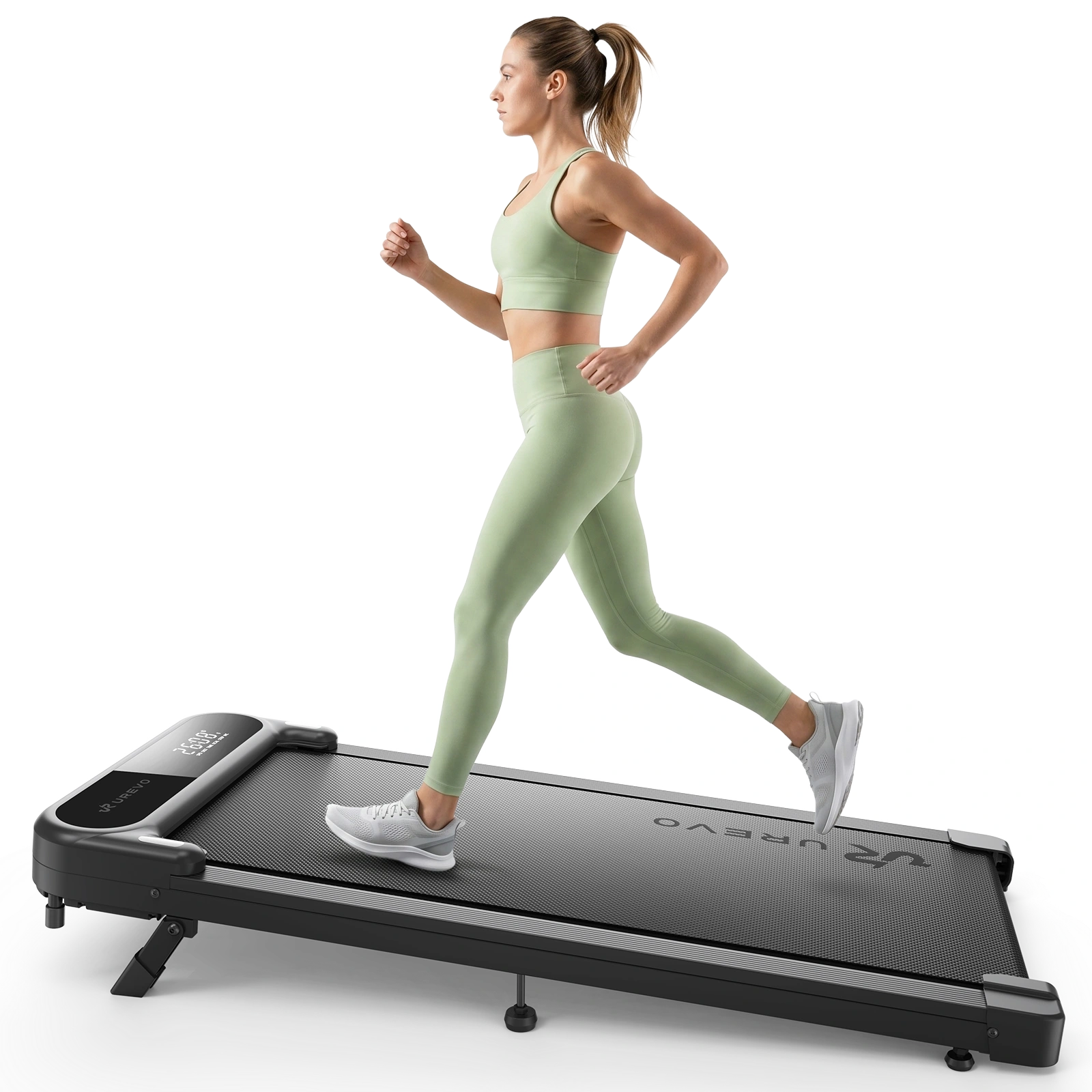
Product photograph: UREVO.
1. Measure between the desk legs
Use the narrowest unobstructed space, including feet, crossbars and cable trays. Compare it with the machine’s complete outer width rather than the walking-belt width. Leave the operating clearances required by the manufacturer.
2. Check desk working height
You will stand on the deck rather than on the floor. Check whether the desk can rise enough for your working position with that additional height. A fixed seated desk does not become suitable simply because a walking pad slides beneath it.
Product height and standing deck height may differ. Do not assume that the tallest housing dimension is the exact amount your body will be raised. Find the relevant dimension in the manual or ask the manufacturer if it is not published.
3. Map the full operating area
Tape out the machine’s outer footprint and add the clearances specified by the exact model’s manual. Check the area behind it as well as the sides. Keep the path clear of furniture, cables and objects that could be pulled toward a moving belt.
A listing that calls a product compact describes relative size, not permission to operate it in a tight gap. Plan a place to reach its controls and use the stopping procedure described by the manufacturer.
4. Measure storage height, width and depth
For an example, the UREVO SpaceWalk E1L Pro product page lists dimensions of 42.9 × 19.3 × 4.5 inches. A nominal 4.5-inch opening is therefore not a sensible guaranteed fit: tolerances, flooring and the way the unit moves into the space still matter.
Use the lowest point under a bed or sofa, including support rails. Check the full insertion depth. A machine that slides halfway under furniture is not fully stored. Store upright only if the exact model’s instructions permit it.
5. Check the moving route and weight
The same UREVO page lists a weight of 35.5 lb. That is useful context when deciding whether you can move it as often as your setup requires. Wheels can help on suitable surfaces, but they do not eliminate thresholds, steps or the need to lift.
Walk the actual route to storage and look for narrow turns. A straight product dimension does not show whether the deck will turn around a desk leg. If moving it would be difficult, a permanent operating location may matter more than a compact storage claim.
6. Check the usable belt and your intended task
UREVO lists a 36.2 × 15.2-inch walking area and a 0.6–4.0 mph speed range for this model. Those figures describe the listing; they do not prove that its belt will suit every person’s stride or that its top speed is appropriate for desk work.
Compare the manual’s intended use with your plans. If running is essential, start with a model explicitly designed and specified for that use. Do not infer suitability from a promotional image.
| Your measurement | Write down |
|---|---|
| Narrowest desk opening | Width plus obstructions |
| Desk height range | Including your position on a deck |
| Operating space | Machine footprint plus manual clearances |
| Storage opening | Lowest height, usable width and full depth |
| Moving route | Turns, thresholds, steps and handling weight |
| Power and flooring | Requirements in the model’s manual |
Worked fit example: a 24-inch desk opening
Using the listed 19.3-inch width above, a 24-inch opening leaves 4.7 inches in total, or 2.35 inches per side if centered. That arithmetic only describes the remaining gap. It does not prove the machine meets its manual’s side clearances, and desk feet or crossbars can reduce the usable opening.
For the 42.9-inch length, draw a second outline that adds the manual’s front and rear clearances. If those values are unavailable, the operating-area check is incomplete. Do not substitute an arbitrary allowance or use the storage dimensions as permission to operate.
| Check | Calculation or observation | What it cannot establish |
|---|---|---|
| Desk width example | 24 − 19.3 = 4.7 inches left | Required side clearance or suitable stride |
| Storage opening | Compare the lowest gap with the whole machine | Ability to tilt, turn or move it into position |
| Operating length | 42.9 inches plus specified front/rear clearance | Safety without the exact manual |
| Daily handling | Check the route and listed 35.5 lb weight | Whether one person can comfortably move it |
Before ordering, also check the seller’s return deadline, packaging rules and possible shipping deductions. UREVO’s US return policy and service-support FAQ currently state different return windows, so obtain written confirmation for your order instead of assuming the longer window applies. Policy wording checked October 5, 2026. Keep enough storage room for the carton while you establish your return options. A machine that fits under a sofa can still leave you with a large box and an expensive return.
Where to go next
If your measurements work, check the UREVO model details and current offer. This manufacturer link is not monetized. If space or handling is the sticking point, compare a mini stepper with a walking pad before spending more.
Sources and limits
Product dimensions and figures come from the linked UREVO page, checked October 2, 2026. This is a space-planning guide based on published information, not a hands-on fit, noise or reliability test.